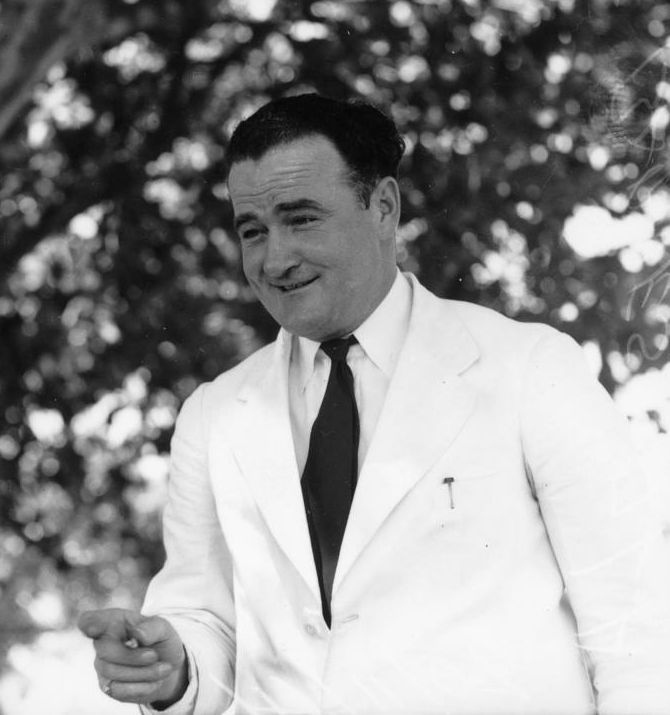
Queensland Independent Labor politician John Francis (Frank) Barnes is one of the most colourful Gorey family members and the only one so far who has served in Parliament.
Frank’s mother was Bridget Maria Gorey, who came from the same village in Ireland as James and Elizabeth Gorey. Through DNA and direct contact with Irish relatives, we know there’s a genetic connection.
Frank Barnes was born in Gympie, Queensland, on 4 October 1904. He was the second son of George Daniel Barnes, a licensed publican, and Bridget Maria, who was born Bridget Gorey. After his parents separated, Frank was raised by his father and educated at the Christian Brothers' High School in Gympie.
Before his political career began, Frank worked as a commercial traveller, selling wine and spirits. In 1937, he became the licensee of the Commercial Hotel in Bundaberg. It was a failed police prosecution against him for selling liquor after hours that set him on an unexpected path into politics.
Frank became passionately convinced that there was widespread corruption among the police and politicians. This conviction led him to launch many successful prosecutions for breaches of the liquor laws himself. His determined efforts earned him the nickname "the Bundaberg Bombshell". He proved to be an able, self-taught lawyer, losing only one of his 31 applications to the Supreme Court of Queensland.
In 1941, standing as an Independent "Andrew Fisher Laborite", Frank won the Legislative Assembly seat of Bundaberg, defeating the Australian Labor Party candidate. His maiden speech, delivered on 2 September, was certainly memorable. He declared his opposition to the Forgan Smith government, boldly stated that "the most important question in life is sex", described the liquor issue as "filthy and disgraceful", spoke against Jewish financial domination, and expressed his sympathy for Social Credit economics. He always maintained he followed the policies of his friend King O'Malley.
This speech marked the beginning of what was described as a "nine years war with parliament". During this time, Frank was suspended from the House eight times. He was known as a robust public speaker, often using extravagant language, yet those who knew him personally found him placid and kindly.
Frank was also a political showman, always impeccably dressed in a white suit and pith helmet. He wasn't above orchestrating incidents to attract public attention. Humour was also part of his political approach. In October 1943, when rebuked by the chairman of committees for not apologising "in a decent and manly way", Frank knelt on the floor, clasped his hands, and humbly intoned: "I humbly withdraw the statement". He was suspended for two weeks.
In late 1942, he claimed that Marjorie Norval, who had been social secretary to Mrs Forgan Smith and was mysteriously missing, had been "shanghaied to California". When he refused to reveal his source to the police, the government amended the Coroner's Act (1930) to make it an offence to withhold such information. Frank again declined to name his source and was jailed by the coroner.
On 1 June 1943, in court, he impenitently named his informants as "Detective Smith" and "Citizen Jones", though he later conceded he had been duped.
Frank had married Everleen Dorothy Buchanan, a munition worker, on 20 January 1943 at the General Registry Office, Brisbane.
His tendency to pursue legal action was a constant annoyance to the government. When he was suspended from parliament, the Speaker ruled that he could not occupy a room at the country members' lodge and directed the police to evict him.
In May 1946, Frank took his case to the Full Court of Queensland and won an assault case against a policeman, successfully arguing that the lodge was not part of Parliament House. He was less fortunate that year when the government passed legislation to garnish his salary to recover a £30 fine, which had been imposed for a breach of parliamentary privilege.
Despite often scandalising his colleagues, Frank managed to hold onto his Bundaberg seat until he was defeated by Labor's EJ Walsh in April 1950. His brother, Lewis (Lou) Barnes, also entered the assembly, winning a by-election for Cairns in October 1942 as a "King O'Malley Laborite".
Frank was a little shorter than his brother Lou, with olive skin and a mop of dark, curly hair. Both brothers were skilled amateur conjurers and accomplished sportsmen; Frank was particularly good at game fishing. Towards the end of Frank's life, the brothers had a serious falling out over Lou's return to the Catholic faith, which both had rejected in their younger years.
Frank faced financial difficulties in his later years. He suffered from chronic renal disease for several years and passed away on 12 May 1952 in Bundaberg from a coronary embolism. He was buried in the local cemetery with Anglican rites, survived by his wife, daughter, and infant son.
Further reading
CITATIONS
BJ Costar, 'Barnes, John Francis (Frank) (1904–1952)', Australian Dictionary of Biography, National Centre of Biography, Australian National University, https://adb.anu.edu.au/biography/barnes-john-francis-frank-9437/text16591, published first in hardcopy 1993, accessed online 25 June 2026. This article was published in hardcopy in Australian Dictionary of Biography, Volume 13, (Melbourne University Press), 1993